SZÓTÓ ZEN SŌTŌ ZEN
« Zen főoldal
« vissza a Terebess Online nyitólapjára

THE PRACTICE OF ZAZEN
 Tartalom |
 Contents |
PDF: Nishijima, Gudo Wafu: Hogyan gyakoroljuk a zazent Dógen mester: Fukanzazengi PDF: Fukan-zazen-gi Keizan Jokin: Zazen Yojinki Terebess Gábor: Shodo Harada Roshi – Mi a Zazen? André Reitai Lemort: Zazen testtartás Ácsán Kalyánó: At ülés művészete (részlet) Shodo Harada Roshi – Bevezetés a zen gyakorlatába https://www.youtube.com/watch?v=myIp08FDfnM Hamvas Béla: Thoreau
PDF: ¿Qué es el Zen? |
Zazen - The Practical Side PDF: How to Practice Zazen PDF: Introduction to Buddhism and the Practice of Zazen PDF: About Zazen PDF: Zazen Instructions Instructions for the Practice of Zazen The Way of Zazen Zazen: Frequently Asked Questions (FAQ) SOTOZEN-NET How to Sit Zen 長蘆宗賾 Changlu Zongze (d. 1107?)
PDF: Fundamentals of Chan Meditation Practice [永平] 道元 希玄 [Eihei] Dōgen Kigen 螢山紹瑾 Keizan Jōkin (1268–1325)
明峰素哲 Meihō Sotetsu (1277-1350) Zazen Katsuki Sekida (関田一喜 Sekida Kazuki, 1893–1987) PDF: Anmo Tuina for Zen Knees PDF: Reader on Shikantaza Upaya Zen Center, Santa Fe, 2013 PDF: Shikantaza: The Methodless Method of Zazen PDF: An electroencephalographic study on the Zen meditation (Zazen), PDF:
Zazen or 'just sitting' practice: from Dogen to Shunryu Suzuki My Footnotes on Zazen &
My Zazen Sankyu PDF: 宇宙いっぱいの坐禅 RTF: Selections from Shikataza PDF: Zazen as an Enactment Ritual PDF: The Art of Just Sitting: Essential Writings on the Zen Practice of Shikantaza PDF: Distinguishing Sōtō and Rinzai Zen: Manas and the Mental Mechanics of Meditation [Kinhin] PDF: Meditation in Motion: Textual Exegesis in the Creation of Ritual Walking > The Atlantic Monthly June 1862 issue |
Gudo Wafu Nishijima
Zazen - The Practical Side
A concrete explanation of Zazen practice itself
http://gudoblog-e.blogspot.hu/2006/12/how-to-practice-zazen.html
(1) Place
Master Dogen instructed for us about a place, where Zazen should be done, concretely in his works, for exsample, Fukan-zazengi, Zazengi in Shobogenzo, and so forth. Therefore if I describe the outline of his opinion about the matter, they are as follows.
1) The place, where Zazen is practiced, is preferable to be indoor. In some lineages, they are sometimes agreeable to practice Zazen outdoors, but Master Dogen recommends ua to practice Zazen indoors. Because in the case of Zazen outdoor the wind might blow and smokes will come, and so the conditions might be inadiquate.
2) The place of Zazen should be always bright day and night. Recently in Japan they like to practice Zazen in a dark Zazen-do, but this habits are completely opposite of Master Dogen's thoughts.
3) The place of Zazen should be warm in a cold season, and it should be cool in a hot season. If someone likes to practice Zazen in a cold place in a cold season, and to practice Zazen in a hot place in a hot season, such a habit is completely opposite of Master Dogen's thoughts. Buddhism can never be similar to a kind of ascetic thoughts.
4) The place of Zazen is preferable to be quiet, but we should not be too much nervous on such a problem, because it is perfectly impossible for us to find an absolutely quiet natural palce on the earth at all.
5) The place of Zazen is not always necessary to be wide, therefore Master Dogen wrote in Shobogenzo Zazengi (58) that "Set aside an area that can contain the body."
6) The place of Zazen are either adequate in a mountain village, or in town. It is not always necessary for us to attach a beautiful natural circumstances.
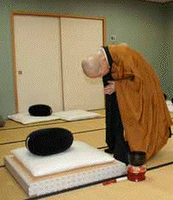
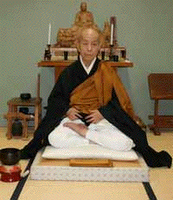
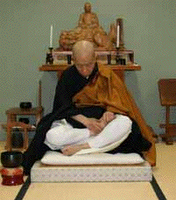
(2) Kashaya (In the picture what I wear, which is light brown, is Kashaya.)
In Shobogenzo (93) Doshin, or The Will to the TruthThere there is a description that "Again, constantly we should wear the Kashaya and sit in Zazen." And those words are understood that not only Buddhist monks and nuns, even secular men and women should wear Kashaya when they practice zazen. Because it is usually supposed that the Chapter Doshin was written not only for Buddhst monks and nuns, but it was written also for laymen and laywomen. Because reading the sentences of the Chapter, we can recognize that the sentences of the Chapter are unusually soft and easy comparing with other chapters of Shobogenzo, and so a Japanese Buddhist scholar supposed that the Chapter might be lectured for not only Buddhist monks and nuns, but also for the constructors, carpenters, and so forth at the time when the buildings of Eihei-ji were just being constructed.
Therefore I have a very strong hope that when we practice Zazen in Dogen Sangha, it is very desirable that all members, not only in the cases of Buddhist monks and nuns, but in the cases of Buddhist laymen and laywomen too, they should inevitably wear Kashaya, when they practice Zazen. Actually, however, if we like to realize such a kind of habits, there are so many difficulties as follows, which should be solved before the accomplishment.
1 ) If we want to buy a sheet of Kashaya in a professional shop today, it is very expensive now, for example, about from 50 thousand yen to 100 thousand yen as the cheapest one in Japanese yen. Therefore in the case of professional Buddhist monks, or nuns, if they use their Kashaya throughout their life for their business, it might be endurable for them to pay such a lot of money, but in general in the case of laymen and laywomen, it might be very difficult for them to pay such a lot of money to pay for their unprofessional matter.
2) Therefore, if we want to have a situation for us to be able to get cheaper Kashaya, it is necessary for us to make our efforts to establish a social system, in which we can supply much cheaper Kashaya to the market acctually.
3) Fortunately, however, it is not impossible for us to supply cheaper Kashayas to the market.
For example, it is not necessary for us inevitably to use silk, which is usually very expensive, therefore we can use a much cheaper chemical fiber actually. On the method of sewing, it is not always necessary for us to rely upon hand-sewing, and so we can utilize the method of using sewing machines. On the problem of size, there are much difference according to a scale of each constitution, which awears it, if we prepare to decide several different sizes beforehand according to the grades, it is possible for us to supply a suitable size of Kashaya to almost all users. As for colors, if we decide a kind of one color, for example, called Mokuran-ji, which is very popular in Soto Sect today, the bright mixture between yellow and brown, it might be possible for us to decrease the cost of Kashaya much more cheaper.
4) Even though it is possible for us to plan such ideas, but for waiting for such a person, or a company to realize the plan, it might be necessary for us to wait for several years, or so, therefoe I think that it might be impossible for us to accomplish such a system before my death, but I am sincerely expect such a kind of production as my rather romantic dream in future.
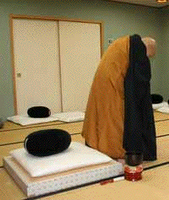
(3) Zafu (In the picture the round black cushion is Zafu.)
When we practice Zazen we usually use a black round cushion, which is called Zafu today. In Fukan-zazen-gi, it is called Futon, and fu means cushion, and ton means round, and so we can interpret that the word "Futon", which indicated the round black cushion for Zazen in the Age of Master Dogen, has become to be used for common bedding today in the long historical processes, and nowadays the cushion, which was called Futon in the Age of Master Dogen, is called Zafu.
1) Zafu is a round cushon, which has a length of about 36 cm as the diameter. It is packed up with kapok so tightly that it holds its hight about from 15 cm to 25 cm even when a practioner sit on it. If we use, for example, cotton for packing, there is possibility that the cotton will become too much hard in a long time, and so it is necessary for us to avoid such a possibility by usin kapok, and so forth.
2) If it was impossible for us to get Zafu, it would be sufficient for us folding a blanket many times to make the thickness of the blanket about 25 cm high, and we can use it as substitute of Zafu. In another case we can pile up 3 or 4 pieces of Zabutons, or Japanese cushions, and we can practice Zazen utilizing the piled up corners of the Japanese cushions too.
3) When we make Zafu by our selves, it is necessary for us to use the cloth, which is not slippery. It is not necessary to be expensive, but it should be strong, and easy in the case of sewing.
4) Even when we use a room, which is covered by Tatami, or Japanese mat made of plant stalks, if we use Zabuton, or Japanese idividual mat, it might be useful to lighten the painfulness of legs.
5) Expecting the cases of monks and nuns, it is sufficient for everyone to wear Kashaya on the ordinary clothes, but having no Kashaya it is also available for everyone to practice Zazen with ordinary clothes. When people have Rakusu, or an abbreviated Kashaya, it is also good for every one to use it.
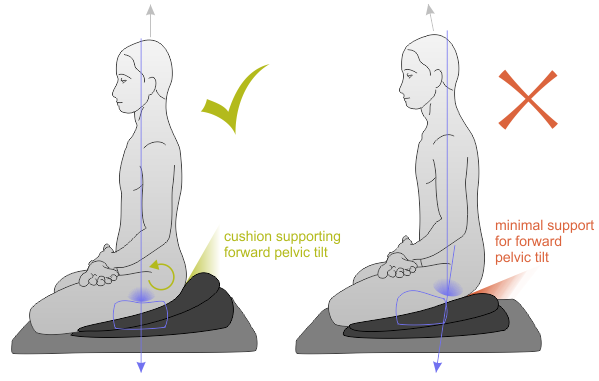
6) In some Buddhist Sects they use a small oblong cushion, which is similar to a small Zabuton, when they practice zazen, but in such a case I am afraid that it might be too much difficult for practioners to keep the spine straight verticully because of the thin cushions, and so it might be too difficult for them to stop their consideration or feeling.
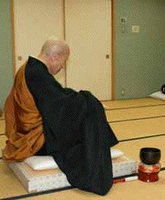
(4) Posture of Zazen
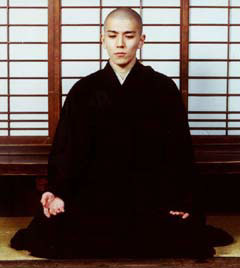
The most important matter in Zazen is the posture of Zazen itself. Because, even though we are practicing Zazen, if we do not have the posture, which is authentic in Buddhist tradition, it is impossible for us to enter into the balanced state of the autonomic nervous system, and so it is also impossible for us to realize Jijuyo-zanmai, or the Samadhi of receiving self and utilizing self. The meaning of Jijuyo-zanmai is that the Jiju, or receiving self, is the function of the parasympathetic nervous system, and the (Ji)yo, or utilizing self, is the function of the sympathetic nervous system. And when the both have become the same strength, and those two factors set off with each other, then the consciousness of consideration is not recognized, and the consciousness of perception is not recognized. Therefore such a situation in Zazen is called "Shinjin-datsuraku, or the state which is free of body and mind."
I guess that many people would doubt whether there were any kind of such a strange situation, which is called "the state which is free of body and mind" in human conditions. Actually thinking, however, in a case of an excellent runner in a hundred meter running, when he is running so sincerely in a race, even though his consciousness is conspicuously clear, but he might be very difficult to consider or perceive anything in his running. Similarly to this example, in our daily life there is a chance, when our consideration and perception have disappear almost completely, and only our action manifests itself so clearly. And I think that the establisher of Buddhism, Gautama Buddha, recognizing such a fact, he noticed that the most important facts in our human life are neither consideration nor perception, but the most important fact in human life must be our real act at the present moment. And I think that his such a kind of very sincere and realistic intuition comes from the fact when he is practicing Zazen having the state of the autonomic nervous system balanced at the present moment.
And the main points of the authentic posture in Zazen might be as follows.
1) First we should keep the lower spine vertically. Master Kodo Sawaki sincerely recommended us to keep the lower spines straight vertically as if the lower spines would be winded forward actually.
2) On the lower spines, which have been kept straight vertically, the backbones should be also placed vertically, but in the case of backbones, they have a natural curve backward, and so we should keep them as straight as possible.
3) We put also the neck straight as far as possible, and so it is necessary for us to keep the chin a little downward and backward. Master Kodo Sawaki told that putting the end of rope a little backward from the top of the head, and we should make our efforts as if we were pulling up the another end of rope to the ceiling vertically.
(5) Folding the legs
(The Half-Lotus Posture)
(A Process to The Full-Lotus Posture)
(The Full-Lotus Posture)
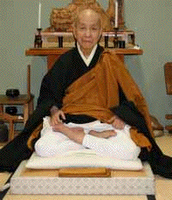
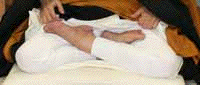
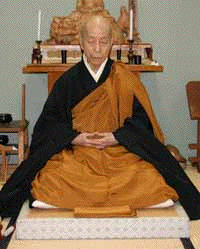
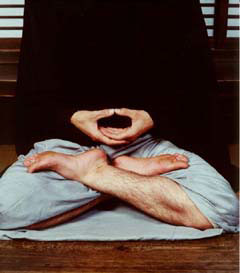
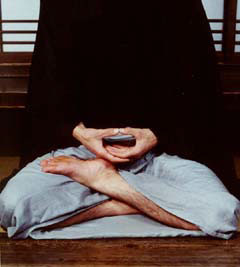
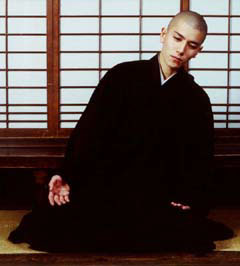
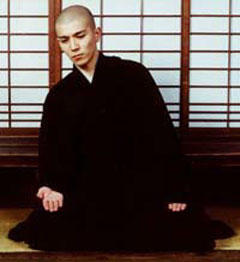
In the methods of folding legs in Zazen, there are two kinds of ways traditionally. The one is called the Half-Lotus Posture, and the other is called the Full-Lotus Posture.
In the case of the Half-Lotus Posture, we place one of the leg on the floor keeping the heel touching zafu. And we put the other foot on the thigh, which is placed on the floor.
In the case of the Full-Lotus Posture, first we make the same posture as the Half-Lotus Posture, and then we put the foot, which is placed on the floor, on the thigh of the other side. Being described with words, it seems to be very hard and painful to keep the posture, and it is true that those postures are sometimes very hard in the case of beginners, but at the same time after the feet have become accustomed, keeping the postures are not so difficult, and when we have accustomed to the postures, we can recognize that the postures of Zazen are rather comfortable.
Before having become accustomed, however, it is very painful for us to keep the Full-Lotus Posture, and so we can suppose that Gautama Buddha has selected the Half-Lotus Posture as also the orthodox posture of Zazen, because of his benevolence to human beings, thinking the very painful situations of the Full-Lotus Posture in the cases of beginners.
Actually in the case of Fukan-zazen-gi by Master Dogen, he wrote the posture of the Full-Lotus Posture exactly that "first put the right foot on left thigh, then put the left foot on the right thigh." But in the case of the Half-Lotus Posture, he wrote in a little vague expression that "just press the left foot onto the right thigh." Therefore we can suppose that Master Dogen described a little easier posture for the Half-Lotus Posture for his benevolence to beginners.
In Fukan-zazen-gi Master Dogen wrote that "put the right hand above the left foot, and place the left hand on the right palm. The thumbs meet and support each other.
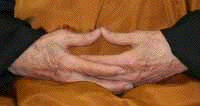
Just make the body vertical and sit straight. Do not lean to the left, incline to the right, slouch forward, or lean backward.
The ears must be aligned with the shoulders, and the nose aligned with the navel. Hold the tongue against the palate, keep the lips and teeth closed, and keep the eyes open. Breathe softly through the nose.
(6) Beginning the practice
When the physical posture is already settled, make one complete exhalation and sway left and right. Sitting immovably in the mountain-still state, "Think about this concrete state beyond thinking." "How can the state beyond thinking be thought about?" "It is different from thinking." This is just the pivot of Zazen.
At the beginning Zazen, we usually hit a bell three times, and the strength of hitting the bell is, the first is the middle, the second is the smaller, and the third is the biggest.
About the right and left of hands and feet, in Fukan-zazen-gi, Master Dogen wrote only the case, in which the just left foot was placed on the right thigh both in the cases of the Half-Lotus Posture and the Full-Lotus Posture, and so in the former time, there was an opinion that Master Dogen permitted us only to use such a specifically decided order, but Master Kodo Sawaki explained that "Master Dogen has described only one example," and thinking about situations I have much prefered Master Kodo Sawaki's opinion.
(7) During Zazen
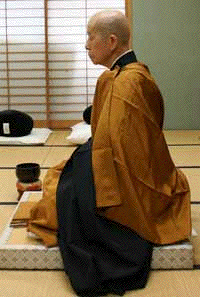
During Zazen, we should not think anything, and we should not feel anything, but we should concentrate our efforts to keep ourselves in the authentic posture. Therefore Zazen is never consideration or perception, but it is just sitting, or action.
But I think that this description might sound very strange in the western societies, because in the western societies there were very excellent idealism and very excellent materialism, but there the philosophy of action hasn't become never popular.
For example in the western civilization the Aristotelian logic is so famous and so powerful, and it has the principles of law of identity, law of contradiction, and law of excluded middle. Among them if we maintain the law of excluded middle, we can never affirm Buddhist philosophy. Because the Buddhist philosophy is based on the affirmation of the middle. Buddhism denied the reality of consideration, and at the same time it denied the reality of sense perception, but it affirmed the real existence of action at the present moment, and so Gautama Buddha could establish the Buddhist philosophy, which is based on human action itself. Therefore we can say that Buddhist philosophy is established on the denial of both idealism and materialism, and the practice of Zazen is just the action, which is perfectly different from idea, or matter, but it is just the middle itself. In other words we are studying just the real action in the practice of Zazen, by keeping our body and mind together in the regular posture. By practicing Zazen we want to ged rid of the area of concideration and perception perfectly to enter into the area of action, or reality itself.
(8) Finishing the practice
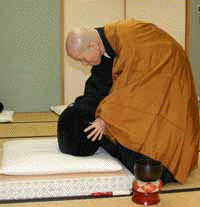
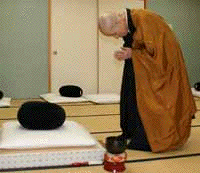
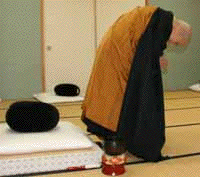
At the end of the practice, we strike a bell once, then we make our heds lower with joining hands. After that, we make our folded legs loose slowly to cure the painful situations of feet and legs gradually, and then we stand up slowly. We should never be hasty, or violent.
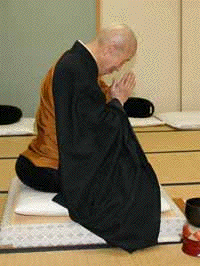
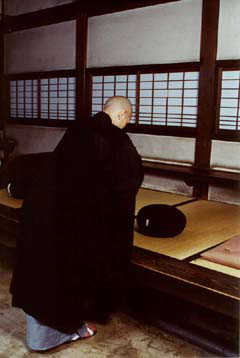
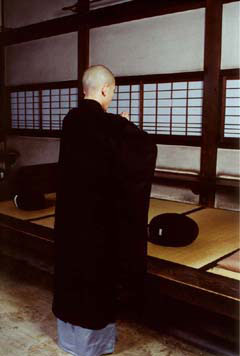
After standing up, it is necessary for us to push the side of Zafu for making the shape round, and bow down to the own seat, then turning around to the opposite side, we should bow down again at the front of the seat. The second bowing is the salutation of all members in the room, but when we practice Zazen alone, we can interpret that the second one is for the salutation to the Universe.
Instructions for the Practice of Zazen
This zazen FAQ is based (with modification) on the publication Shikantaza: An Introduction to Zazen published by the Kyoto Soto-Zen Center. Some sectarian differences are noted under Difficulties and Expedients. The main text is minimalist in aiming to present what is most common in as many teaching lines as practicable.
Terms for zazen
Gasshō: (Korean: hapchang): See under Hand Positions.
Hokkaijoin: (Cosmic Mudra): See under Hand Positions.
Hondo: A formal hall for rituals and ceremonies. The altar is against a wall in a hondo.
Isshu: See under Hand Positions.
Kinhin: Walking zazen.
Rinzai: A Japanese (Chinese: Linji) sect of Zen Buddhism.
Shashu: See under Hand Positions.
Sodo: A formal hall for meditation, meals, and sleeping. The altar is in the center of a sodo.
Soto: A Japanese (Chinese: Caodong) sect of Zen Buddhism.
Zafu: A small round cushion used as a seat in zazen.
Zabuton: See Zaniku.
Zaniku: A large reactangular flat cushion placed under the zafu which cushions the knees.
Zendo: An informal hall for zazen is practice, which may combine the function and layout of a sodo and hondo.
Zendo Manners
Hand Positions
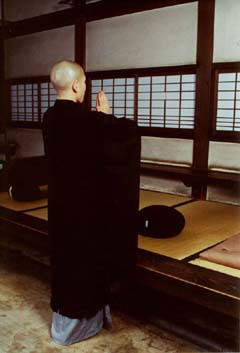
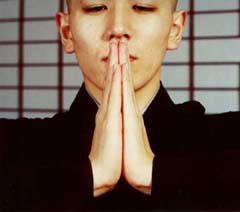
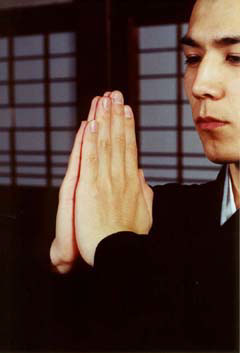
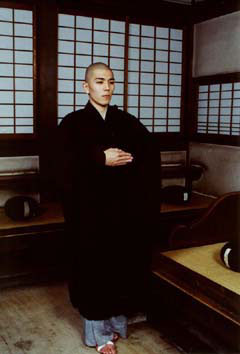
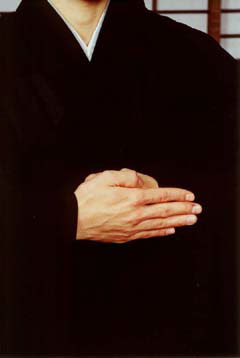
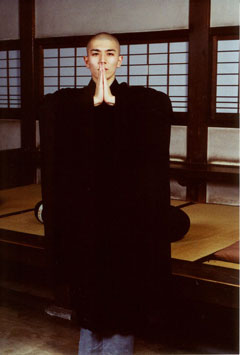
Gasshō is performed by placing the hands palm to palm slightly in front of the chest with the arms parallel to the floor.
Shashu is performed by placing the thumbtip of the left hand as close to the left palm as comfortable and making a fist around it. Place the fist in the center of the chest and cover it with the right hand. Keep the elbows away from the body with the forearms parallel to the floor.
Isshu is the same as shashu but with the left fist turned thumb side toward the chest. Left fist and thumb are parallel to the floor and not vertical as in shashu.
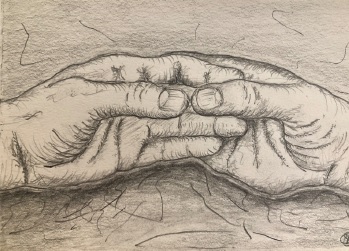
Hokkaijoin
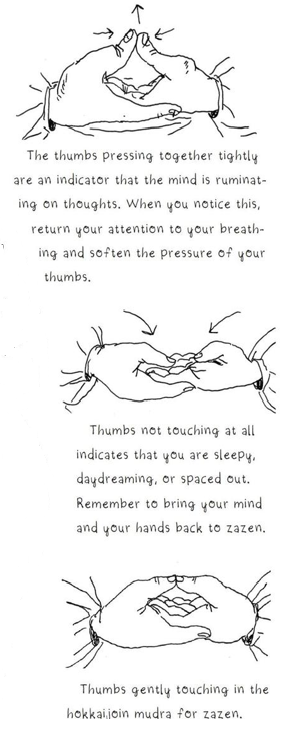
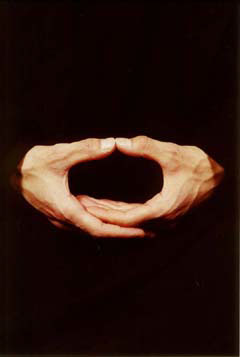
(Cosmic Mudra) is performed in the following manner. Place your right
hand palm upward in your lap against the lower abdomen. Place the left hand
palm upward on top of the right. The second joints of the middle fingers should
be touching, and your fingers parallel. Raise the thumbs up opposite the fingers
and touch the thumb tips lightly together; forming an oval between the thumbs
and fingers. The thumb tips should join at the approximate level of the navel.
In some Tibetan teaching lines the right hand is placed on top of the left.
The thumbs should touch lightly. You can gauge you state of mind based on the thumbs:
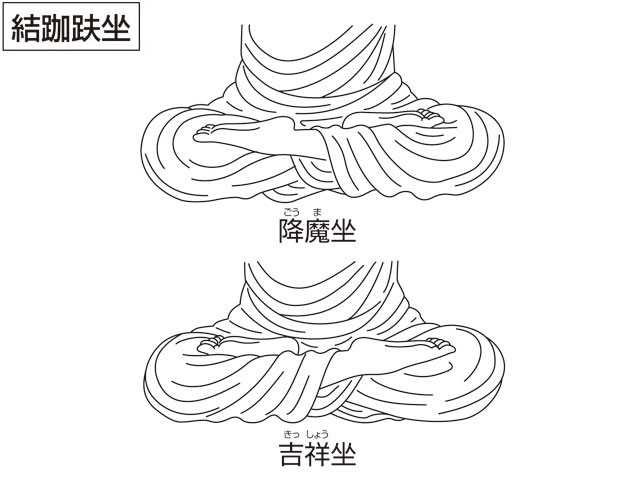
結跏趺坐 kekkafuza : manière de s’asseoir en croisant les jambes et posant chacun des pieds sur les cuisses.
gōmaza (降魔坐) la posture de l'ascète; « reddition du démon »; Sitting in Practice; Subjugating posture; „ördögűző póz” = ha a bal lábfej a jobb comb fölött van.
kichijōza (吉祥坐 ou rengeza 蓮華坐) la posture de l'éveillé; « bons auspices »; Sitting in Verification; Auspicious posture; „szerencseszerző póz” = ha a jobb lábfej a bal comb fölött van.
法界定印 Hokkai-join:
If you are in a gōmaza posture, keep your left hand on top of the right; a bal kéz a jobb tenyér fölött.
If you are in a kichijōza posture, keep the right hand on top; a jobb kéz a bal tenyér fölött.
Ácsán Kalyánó: At ülés művészete (részlet)
Fordította: Nagy Tibor
Settling Into the Posture
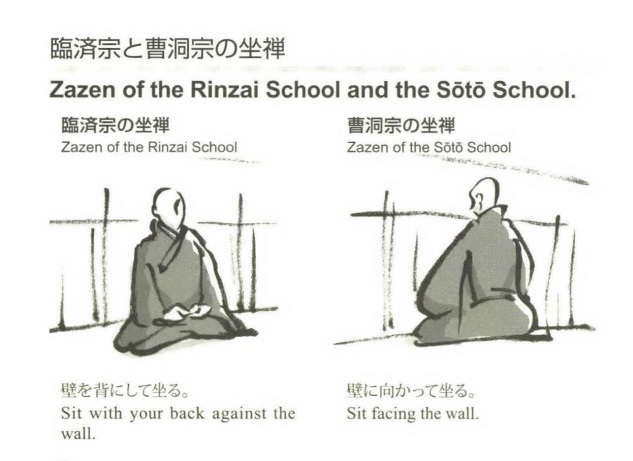
Place a thick mat (zaniku or zabuton) in front of the wall and place a small round cushion (zafu) on it. Sit on it facing the wall. There are several positions for the legs. If not too cold sit with bare feet. Leave your wristwatch off.
The cross legged positions provide greatest stability. To sit in full lotus, place the right foot on the left thigh and then the left foot on the right thigh. To sit in half lotus place your left foot on your right thigh. Try to cross the legs firmly so that a stable tripod of support is provided by the knees and the base of the spine. The order of the crossing of the legs may be reversed. It is also possible to simply sit on the floor with one foreleg in front of the other or kneeling using a bench or a cushion. To sit in a chair, place the feet flat on the floor and use a cushion to elevate the seat so that the upper thighs fall away from the body and follow the rest of the applicable instructions.
Rest the knees firmly on the zaniku, straighten the lower back, push the buttocks outward and the hips forward, and straighten your spine. Pull in your chin and extend the neck as though to support the ceiling. The ears and shoulders should be in the same plane with the nose directly above the navel. Straighten the back and relax shoulders, back, and abdomen without changing posture.
Keep the mouth closed placing the tongue with the tip just behind the front teeth and the rest of the tongue as close to the roof of the mouth as comfortable. Keep the eyes at least slightly open cast downward at a 45 degree angle without focusing on anything. If closed you may slip into drowsiness or daydreaming.
Rest the hands palm up on the knees and take 2 or 3 deep abdominal breaths. Exhale smoothly and slowly with the mouth slightly open by pulling in on the abdominal wall until all air has been expelled and inhale by closing the mouth and breathing naturally. Hands still on the knees sway the upper half of the body left to right a few times without moving the hips. Sway forward and back. These swayings are at first larger and then smaller enabling you to find the point of balance of your posture.
Finally, place your hands in Hokkaijoin (Cosmic Mudra, the oval shape against your abdomen described above under Hand Positions).
Breath
Observe breathing during zazen, but do not try to manipulate the rhythm or depth of the breath. Breathe gently and silently through the nose without attempting to control or manipulate the breathing. Let the breath come and go naturally so that you forget all about it. Simply let long breaths be long and short ones short. On inhalation the abdomen expands naturally like a ballon inflating, while on exhalation simply let it deflate. There are some additional remarks about breathing under Difficulties And Expedients.
In some Rinzai and Tibetan teaching lines it is recommended that one feel a sense of strength in the abdomen in breathing, that the exhala- tion be done in a very slow smooth and gradual way or a very slight contraction of the anus on exhalation (this should be so slight it may be more felt as an intention than as a physical contraction) be per- formed. While these recommendations have their origin in energy yogas (Kundalini and Qigong) some Tibetan and Rinzai teachers recommend their use. Theravada and Soto teachers in general do not recommend this approach. Soto especially emphasizes just observing the breath as it is without trying to improve it in any way. Specifically, Dogen states that counting the breath and following it are not quite zazen and recommends avoiding their use. Some lineages (mostly Rinzai) recommend a long period of breath counting before simply practicing zazen, others (mostly Soto) do not. Similarly, some recommend that if you are without a teacher, only practice breath counting not zazen, others encourage practice with or without a teacher.
Awareness
Do not concentrate on any particular object or attempt to control thoughts, emotions, or any modification of consciousness. By simply maintaining proper posture and breathing the mind settles by itself without fabrication. When thoughts, feelings, etc. arise, do not get caught up by them or fight them. Simply permit any object of mind to come and go freely. The essential point is to always strive to wake up from distraction (thoughts, emotions, images, etc.) or dullness and drowsiness. Letting go of any thought is itself thinking non thinking.
Arising From Zazen
Bow in gasshō. Place hands on the knees and sway the body slightly and then more so. Take a few deep breaths and unfold the legs. Arise slowly especially if the legs are asleep and do not stand abruptly. Return your sitting place to its original condition. (Plump up the zafu and brush it off with your hand.)
Kinhin - Walking Zazen
Place the hands in shashu (or isshu). Walk clockwise around the room so that your right shoulder is toward the altar in the center of the zendo. The posture from waist up is the same as in zazen. Walk taking a half step for each full breath, slowly, smoothly, and noiselessly, without dragging the feet. Always walk straight ahead and turn to the right. Rinzai kinhin is often much faster and the pace may vary. Match your pace to that of the group.
Difficulties and Expedients
The art of right awareness may seem difficult and the description given above is idealized. If you are finding difficulties invent your own way. In zazen we each must find our own way. If you find you are struggling and need a suggestion as to what to do, it is possible to follow or count the breath among other things.
Counting the breath may be done on inhalations, exhalations or both depending on what you find useful. Count from one to ten and then simply start over again at one. Be aware of the count and the breath and try to maintain continuous awareness of both. If you find that you are constantly losing the count, try counting to five.
Following the breath is done by watching the rise with inhalation and fall with exhalation of the abdomen with each breath. The abdominal wall is viewed as a leaf slowly waving in response to the in and out breaths. Maintain awareness of the entire posture as much as possible and watch the breath reach and leave the lower abdomen.
Please note that opposite breathing (abdomen in on exhalation, out on inhalation) is a Taoist Qigong (energy yoga) method and is not appropriate to do with zazen since it has a specific, health related purpose.
Keizan Zenji recommends settling awareness in the abdomen if bothered by distracting thoughts and above the eyebrows or at the hairline if bothered by drowsiness. Others recommend watching contact of the air with the nostrils or upper lip if drowsy. Dogen Zenji mentions only the palm of the left hand as a point of concentration in difficulties. Hakuin Zenji also mentions slowly scanning the attention from the top of the head downward throughout the body, like following a slowly melting substance as a specific remedy against excess nervousness in zazen. These are mentioned here only as examples of the expedient devices that have been adopted by others. Remember these are only for use in difficulty, the norm of awareness for zazen is to be awake without preference to everything in the universe regardless of whether it is inside or outside the body. Be awake to everything over and over again, that is the essential art of zazen.
Zazen Ritual
http://web-japan.org/museum/others/zazen/zazen_01.html
Customs
When a person starts or ends sitting in a place designed for the practice of "zen" either alone or together with other people, the hands should be joined in prayer to symbolize respect and gratitude. This is done, joining the hands and fingers lifting the elbows slightly and bowing deeply. The joining of hands "Gasshō" expresses the "oneness" of the mind.
Gasshō:
(2) 合掌 Gasshō
Hold the palms and fingers of both hands together. Gasshō is an expression of respect, faith and devotion. Because the two hands (duality) are joined together, it expresses the "One-Mind"
(1) 合掌 Gasshō
(3) 合掌 Gasshō
隣位問訊 Rin'i-monjin: At your seat, bow in gasshō toward the zafu and turn clock wise.
対坐問訊 Taiza-monjin: Bow in Gasshō toward the opposite side of the hall.
(4) 合掌 Gasshō
(5) 合掌 Gasshō
(6) 合掌 Gasshō
Sitting
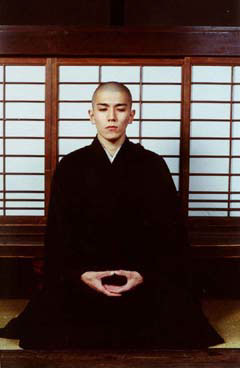
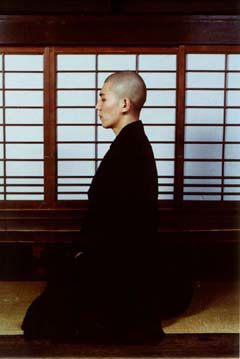
The way of sitting for Zen practice, "kekka-fuza" is similar to that of yoga. Namely, a person should place the right foot on the left thigh and the left foot on the right thigh. This posture is difficult to achieve for unaccustomed or overweight people who are permitted to adopt a half-sitting position, "hanka-fuza", by simply placing the right foot on the left thigh. After sitting, the left hand should be placed palm up on the right one and the two thumbs should be joined. The spine should be held rigidly upright, the hips pushed slightly backward, the jaw pulled to the chest and the neck relaxed and free of intentional force. The mouth should be shut and the gaze directed at the ground at a distance of about a meter.
(1) Posture of the trunk
Sit straight, leaning neither to the left nor to the right, neither forward nor backward.
(2) 結跏趺坐 Kekka-fuza
Put your right foot on your left thigh, and your left foot on your right thigh.
(3) 半跏趺坐 Hanka-fuza
Put just your left foot on your right thigh.
(4) 法界定印 Hokkai-join
Place your right hand palm-up on your left foot, and your left hand palm-up on your right palm. The tips of your thumbs should be lightly touching each other.
Respiration
A deep breath is required at first by slowly and quietly exhaling from the mouth. The air should be inhaled through the nose, also slowly and quietly. After repeating the nose inhalation and mouth exhalation for about 10 cycles to stabilize the respiration, continuous quiet respiration through the nose should be started.
(1) The eyes
Keep your eyes slightly open. Cast them downward at about a 45° angle. Without focusing on any particular thing, let everything have its place in your field of vision. If your eyes are closed, you will easily drift into drowsiness or day-dreaming.
Concentration
When entering the quiet meditation status, a person should concentrate all his spiritual energy to a point immediately below the navel (the "Tanden"). The rhythm of respiration should not be disturbed and it should be imagined that energy enters and leaves the body through the arches of the feet.
(1) 欠気一息 Kanki-issoku
(Exhale completely and take a breath) Quietly make a deep exhalation and inhalation. Slightly open your mouth and exhale smoothly and slowly. In order to expel all the air from your lungs, exhale from the abdomen. Then close your mouth and inhale through your nose naturally. This is called kanki-issoku.
Awareness (覚触 Kakusoku)
Do not concentrate on any particular object or control your thought.
Yet, when you maintain a proper posture and your breathing settles down, your mind will naturally become tranquil as well.
When various thoughts arise in your mind, do not become caught up by them or struggle with them; neither pursue nor try to escape from them. Just leave them alone, allowing them to come up and go away freely.
The most essential thing in doing zazen is to awaken (kakusoku) from distraction (thinking) or dullness (drowsiness) and return to the right posture moment by moment.
- The bell
The bell is rung to signal the beginning and end of zazen.
When zazen begins, the bell is rung three times (止静鐘 shijōshō). When kinhin begins, the bell is rung twice (経行鐘 kinhinshō). And when kinhin is finished, the bell is rung once (抽解鐘 chūkaishō).
Also, when zazen is finished, the bell is rung once (放禅鐘 hōzenshō).
Repose
If a person becomes tired from long hours of spiritual concentration, "zen" permits movements of the body to the left and right, a rearrangement of posture or standing up and walking in half steps. When walking, the person should clench the left hand with the thumb inside, clasp the left fist with the right hand placing both hands at the front of the body (a posture referred to as "Shashu").
(1)-(3) 左右揺振 Sayū-yōshin
Sway the trunk from side to side, decreasing the angle of the movement untilyou stop in the center, and sit immovably.
Rest the your spine in the center of the zafu.
(1) 左右揺振 Sayū-yōshin
(2) 左右揺振 Sayū-yōshin
(3) 左右揺振 Sayū-yōshin
(4)-(5) 叉手 Shashu
Put the thumb of your left hand in the middle of the palm and make a fist around it. Place the fist in front of your chest. Cover the fist with your right hand. Keep your elbows away from your body forming a straight line with both forearms.
(4) 叉手 Shashu
(5) 叉手 Shashu
(6) 経行 Kinhin / 歩行禅 Hokōzen - Walking Meditation
Hold your hands in shashu. Take half a step for every breath.
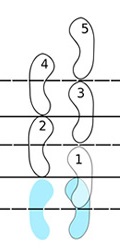
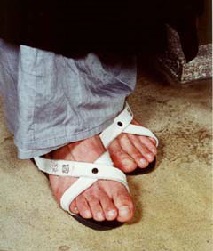
Zazen: Frequently Asked Questions (FAQ)
This is based upon a pamphlet from the Kyoto Soto Zen Center with modifications.
In a zendo the altar is placed in the center of the room. Enter the zendo on the left side of the entry, left foot first. Gassho and bow to the altar.
Walk forward across the room past the altar and go to a seat turning corners squarely (cross in front of the altar only during kinhin). Gassho and bow toward the seat, greeting the people to both sides. The people on both sides respond to greeting. Turn clockwise and face front.
Gassho and bow to those directly across room, greeting them. They respond with a gassho-bow in greeting. Sit down on the zafu. Turn clockwise toward the wall.
HAND POSITIONS
Gassho is performed by placing the hands palm to palm slightly in front of the chest with the arms parallel to the floor.
Shashu is performed by placing the thumbtip of the left hand as close to the left palm as comfortable and making a fist around it. Place the fist in the center of the chest and cover it with the right hand. Keep the elbows away from the body with the forearms parallel to the floor.
Isshu is the same as shashu but with the left fist turned thumb side toward the chest. Left fist and thumb are parallel to the floor and not vertical as in shashu.
SETTLING INTO THE POSTURE
Place a thick mat (zaniku or zabuton) in front of the wall and place a small round cushion (zafu) on it. Sit on it facing the wall. There are several positions for the legs. If not too cold sit with bare feet and leave your watch off.
The cross legged positions provide greatest stability. To sit in full lotus, place the right foot on the left thigh and then the left foot on the right thigh. To sit in half lotus place your left foot on your right thigh. Try to cross the legs firmly so that a stable tripod of support is provided by the knees and the base of the spine. The order of the crossing of the legs may be reversed. It is also possible to simply sit on the floor with on foreleg in front of the other or kneeling using a bench or a cushion. To sit in a chair, place the feet flat on the floor and use a cushion to elevate the seat so that the upper thighs fall away from the body and follow the rest of the applicable instructions.
Rest the knees firmly on the zaniku, straighten the lower back, push the buttocks outward and the hips forward, and straighten your spine. Pull in your chin and extend the neck as though to support the ceiling. The ears and shoulders should be in the same plane with the nose directly above the navel. Straighten the back and relax shoulders, back, and abdomen without changing posture.
Keep the mouth closed placing the tongue with the tip just behind the front teeth and the rest of the tongue as close to the roof of the mouth as comfortable. Keep the eyes at least slightly open cast downward at a 45 degree angle without focusing on anything. If closed you will easily slip into drowsiness or daydreaming.
Rest the hands palm up on the knees and take 2 or 3 deep abdominal breaths. Exhale smoothly and slowly with the mouth slightly open by pulling in on the abdominal wall until all air has been expelled and inhale by closing the mouth and breathing naturally. Hands still on the knees sway the upper half of the body left to right a few times without moving the hips. Sway forward and back. These swayings are at first larger and then smaller enabling you to find the point of balance of your posture.
Finally, place your right hand palm upward in your lap against the lower abdomen. Place the left hand palm upward on top of the right. The second joints of the middle fingers should be touching, and your fingers parallel. Raise the thumbs up opposite the fingers and touch the thumb tips lightly together; forming an oval between the thumbs and fingers. The thumb tips should join at the approximate level of the navel. Keep this shape carefully and gently, without tension.
BREATH
Observe breathing during zazen, but do not try to manipulate the rhythm or depth of the breath. Breathe gently and silently through the nose without attempting to control or manipulate the breathing. Let it come and go naturally so that you forget all about it. Simply let long breaths be long and short ones short.
AWARENESS
Do not concentrate on any particular object or attempt to control thoughts. By simply maintaining proper posture and breathing the mind settles by itself without fabrication. When thoughts arise, do not get caught up by them or fight them. Simply permit them to come and go freely. The essential point is to always strive to wake up from distraction and thoughts or dullness and drowsiness. Letting go of any thought is itself thinking non thinking.
ARISING FROM ZAZEN
Bow in gassho. Place hands on the knees and sway the body slightly and then more so. Take a few deep breaths and unfold the legs. Arise slowly especially if the legs are asleep and do not stand abruptly.
KINHIN - WALKING ZAZEN
Place the hands in shashu (or isshu). Walk clockwise around the room so that your right shoulder is toward the altar in the center of the zendo. The posture from waist up is the same as in zazen. Walk taking a half step for each full breath, slowly, smoothly, and noiselessly, without dragging the feet. Always walk straight ahead and turn to the right.
DIFFICULTIES AND EXPEDIENTS
The art of right awareness may seem difficult and the description given above is idealized. If you are finding difficulties invent your own way. In zazen we each must find our own way. If you find you are struggling and need a suggestion as to what to do, it is possible to follow or count the breath among other things.
Counting the breath may be done on inhalations, exhalations or both depending on what you find useful. Count from one to ten and then simply start over again at one. Be aware of the count and the breath and try to maintain continuous awareness of both. If you find that you are constantly losing the count, try counting to five.
Following the breath is done by watching the rise and fall of the abdomen with each breath. The abdominal wall is viewed as a leaf slowly waving in response to the in and out breaths. Maintain awareness of the entire posture as much as possible and watch the breath reach and leave the lower abdomen.
Keizan Zenji recommends settling awareness in the abdomen if bothered by distracting thoughts and above the eyebrows or at the hairline if bothered by drowsiness. Others recommend watching contact of the air with the nostrils or upper lip if drowsy. Dogen Zenji mentions only the palm of the left hand as a point of concentration in difficulties. These are mentioned here only as examples of the expedient devices that have been adopted by others. Remember these are only for use in difficulty, the norm of awareness for zazen is to be awake without preference to everything in the universe regardless of whether it is inside or outside the body. Be awake to everything over and over again that is the essential art of zazen.